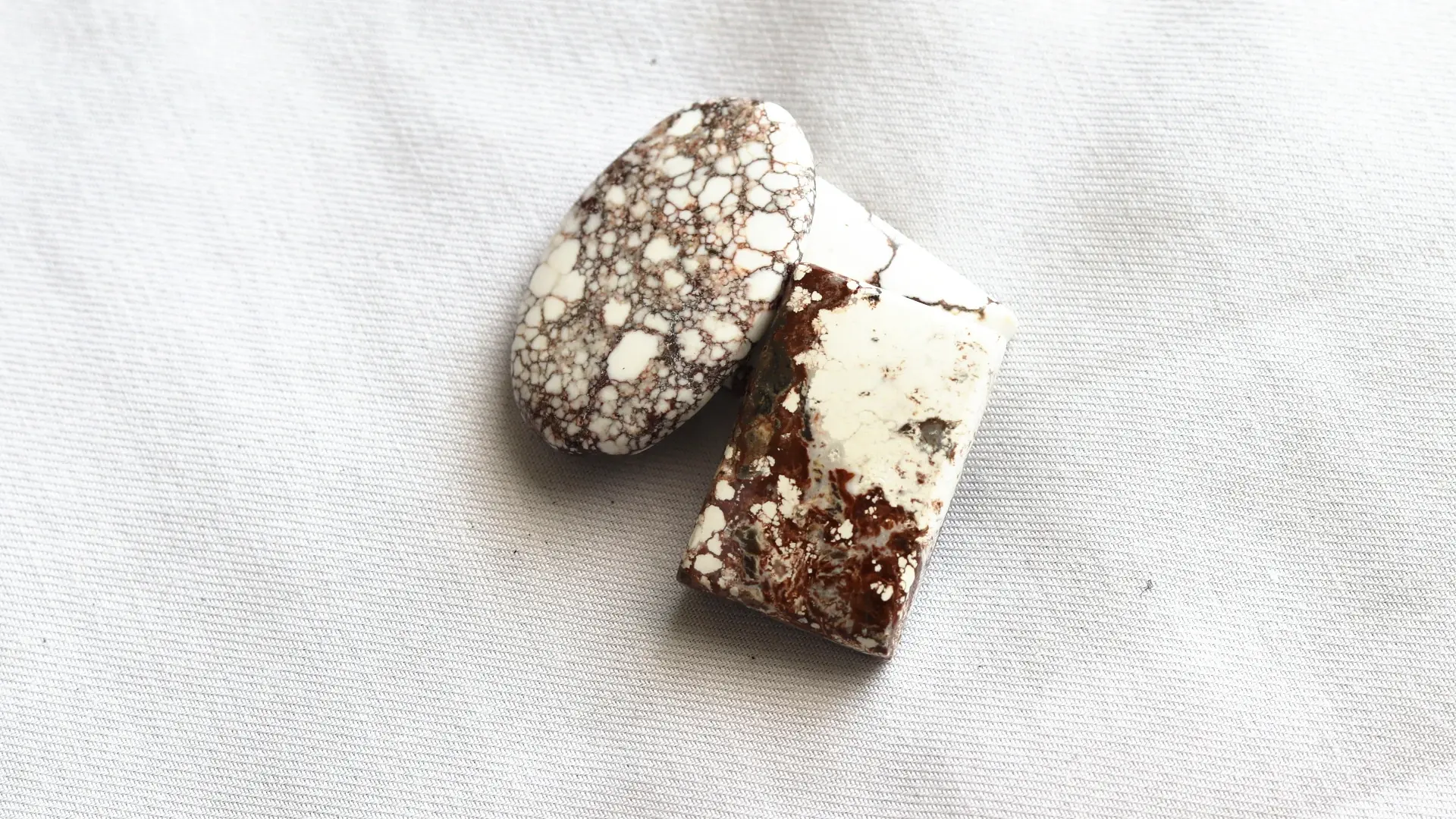
Wild Horse
A trade name for white magnesite with reddish brown hematite, from one place in Arizona. It is sometimes called turquoise, but there is no turquoise in it.
The photo shows three polished stones: an oval one, with white patches surrounded by a fine web of brown and grey lines, and two rectangular ones, with large cream areas and reddish brown patches. "Wild Horse" is not a mineral name but a trade name. According to Enchanting Earth and FossilEra, it is a natural combination of magnesite, a white mineral, and hematite, an iron oxide that gives the reddish brown. According to Rincon Trading, the name comes from the brown and white patterns, which resemble the wild horses of the American West.
It is sometimes sold as "Wild Horse turquoise", but there is no turquoise in it. So why turquoise? According to Geology.com, white magnesite cabochons with a grey, black or brownish "matrix" remind people of turquoise, so they are sometimes called "white turquoise", which is a misnomer. And there is a less innocent side: white magnesite is porous and absorbs dye easily, and according to Geology.com, for nearly 100 years it has been dyed blue and sold as a turquoise substitute, sometimes disclosed and sometimes not. Our stones stayed white and brown, and did not try to pass as anyone else.
According to FossilEra, Wild Horse comes from near the Globe copper mine in southeastern Arizona. According to the site, it forms through low-grade metamorphism, at 200 to 320 °C and low pressure, when magnesium-rich rock meets a carbonate-rich solution. The result is a rock with white magnesite plumes set in a reddish brown, hematite-rich matrix. According to Enchanting Earth, it comes from a single area only, so the pieces are usually small.
It is worth knowing that it is soft. According to Geology.com, magnesite has a hardness of 3.5 to 5, and according to Enchanting Earth, Wild Horse is 3.5 to 4.5. That is much softer than quartz, so it is best taken off before a gym session, and kept away from harder stones.
And finally, some family perspective. According to Geology.com, most magnesite in the world never becomes jewelry: it is heated to make magnesium oxide, which is used mainly for heat-resistant bricks that line kilns and blast furnaces. So while its relatives work in the furnace, Wild Horse poses on white fabric.
Crystal traditions
In crystal tradition
According to Enchanting Earth, Wild Horse is considered a stone of grounding, endurance and protection, and "a stone that awakens your wild and free spirit". The site links it to the root and crown chakras, to the earth element, and to Sagittarius, Capricorn and Virgo. According to Rincon Trading as well, it is associated mainly with the root chakra and a sense of stability.
Sources: Wild Horse Meaning and Healing Properties, Enchanting Earth; Arizona Wild Horse Magnesite with Hematite, Rincon Trading
Scientific information
Properties
Type: a trade name for a rock of magnesite (magnesium carbonate, MgCO₃) with hematite (iron oxide, Fe₂O₃).
Crystal system of magnesite: trigonal.
Mohs hardness: 3.5 to 5 (magnesite).
Specific gravity of magnesite: 3.0 to 3.2.
Luster of magnesite: dull, earthy or chalky, rarely vitreous. Opaque.
Formation: low-grade metamorphism (200 to 320 °C, low pressure) of magnesium-rich rock in the presence of a carbonate-rich solution.
Source: the Globe area, Arizona, USA.
Other market names: Wild Horse magnesite, Crazy Horse, Wild Horse turquoise (misleading).
Sources: Magnesite: A mineral used as a gem and in industry, Geology.com; Hematite: A primary ore of iron and a pigment mineral, Geology.com; Wild Horse Magnesite For Sale, FossilEra; Wild Horse Meaning and Healing Properties, Enchanting Earth; Arizona Wild Horse Magnesite with Hematite, Rincon Trading
Associations
Different traditions associate this stone with different things, and they sometimes conflict. Each association is shown with its tradition and sources.
Zodiac sign
SagittariusCrystal tradition
Sources: Wild Horse Meaning and Healing Properties, Enchanting Earth
Zodiac sign
CapricornCrystal tradition
Sources: Wild Horse Meaning and Healing Properties, Enchanting Earth
Zodiac sign
VirgoCrystal tradition
Sources: Wild Horse Meaning and Healing Properties, Enchanting Earth
Element
EarthCrystal tradition
Sources: Wild Horse Meaning and Healing Properties, Enchanting Earth
Chakra
RootCrystal tradition
Sources: Wild Horse Meaning and Healing Properties, Enchanting Earth; Arizona Wild Horse Magnesite with Hematite, Rincon Trading
Chakra
CrownCrystal tradition
Sources: Wild Horse Meaning and Healing Properties, Enchanting Earth
Sources
- Magnesite: A mineral used as a gem and in industry, Geology.comAccessed September 24, 2026
- Hematite: A primary ore of iron and a pigment mineral, Geology.comAccessed September 24, 2026
- Wild Horse Magnesite For Sale, FossilEraAccessed September 24, 2026
- Arizona Wild Horse Magnesite with Hematite, Rincon TradingAccessed September 24, 2026
- Wild Horse Meaning and Healing Properties, Enchanting EarthAccessed September 24, 2026
More crystals
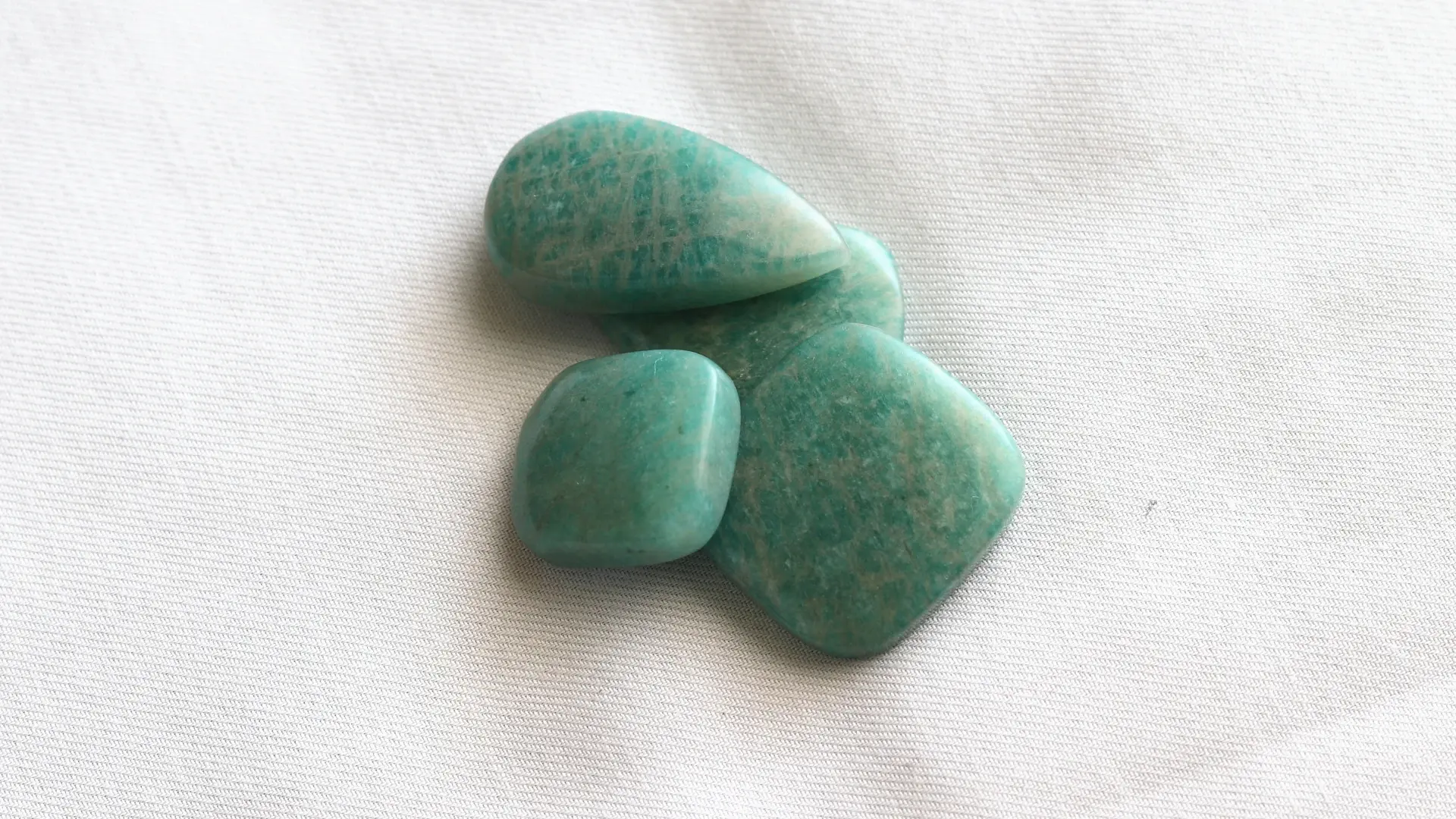
Amazonite
A turquoise-green variety of the feldspar microcline. Despite the name, it does not come from the Amazon.
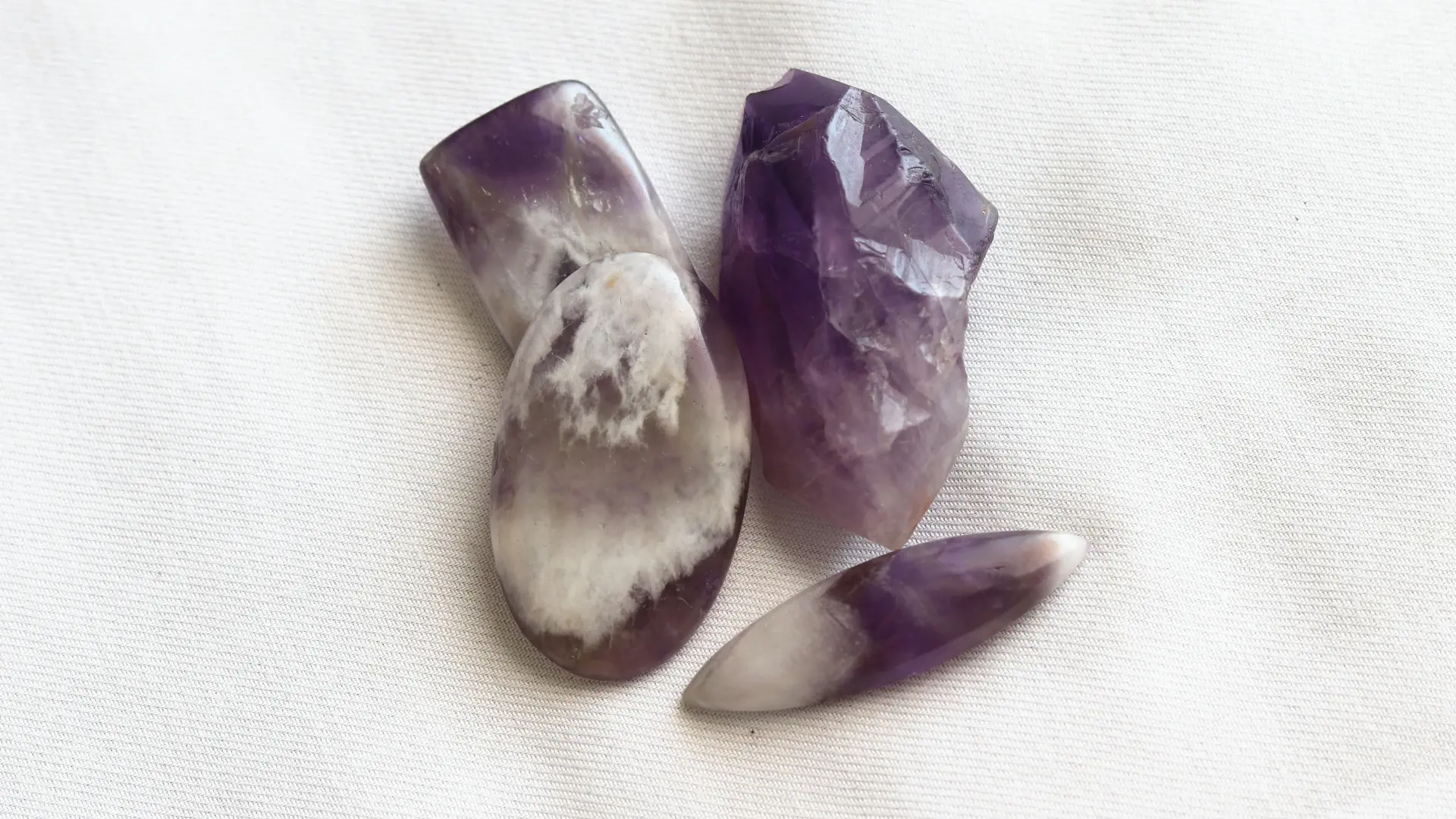
Amethyst
Purple quartz whose Greek name means "not drunk". By the common identification, one of the breastplate stones, and one of the best-loved stones in the world.
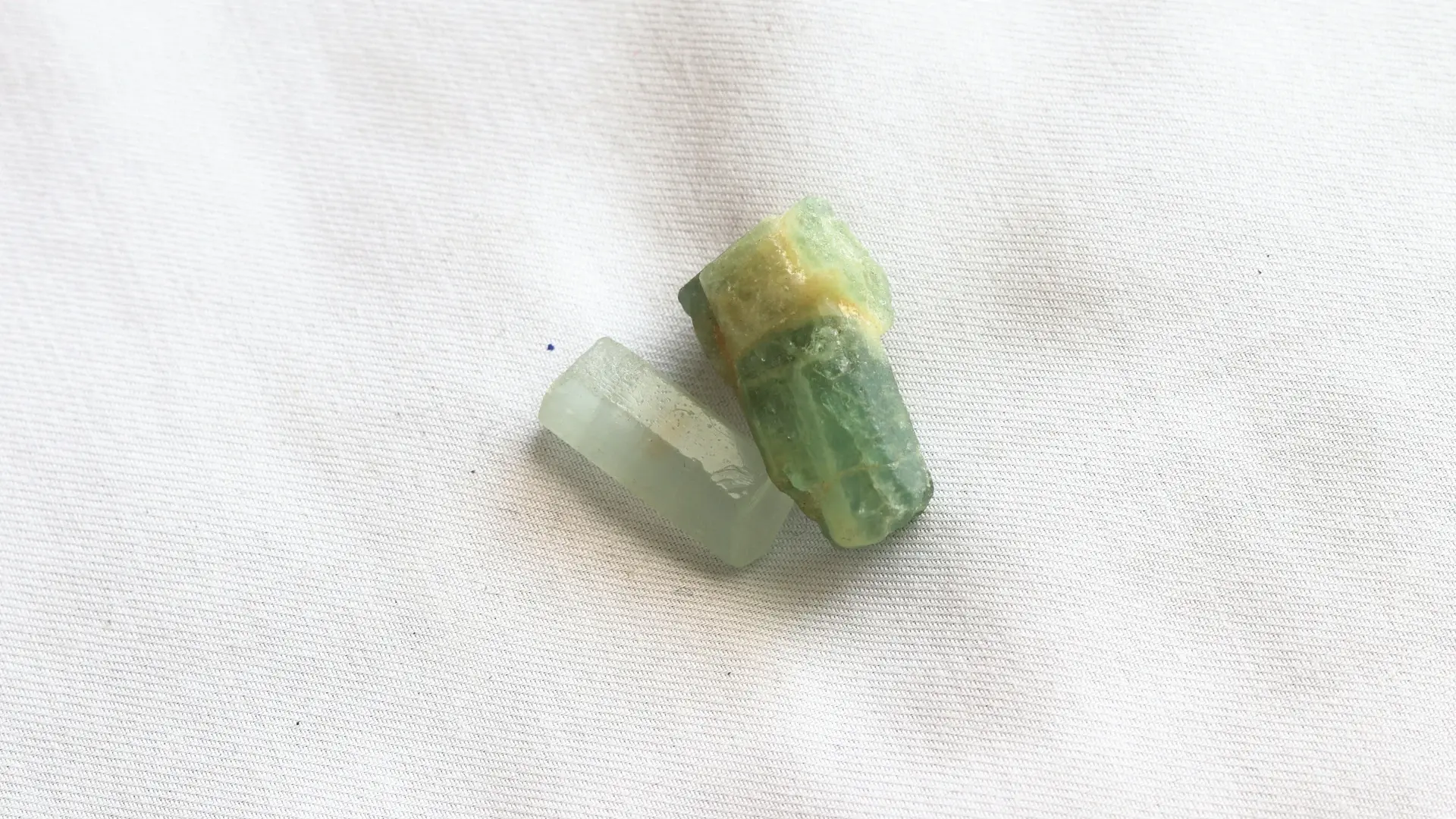
Aquamarine
The blue-green variety of beryl, a close relative of emerald. Its name means "seawater".
Atlantisite
A natural mix of green serpentine and purple stichtite, from a single hill in Tasmania.