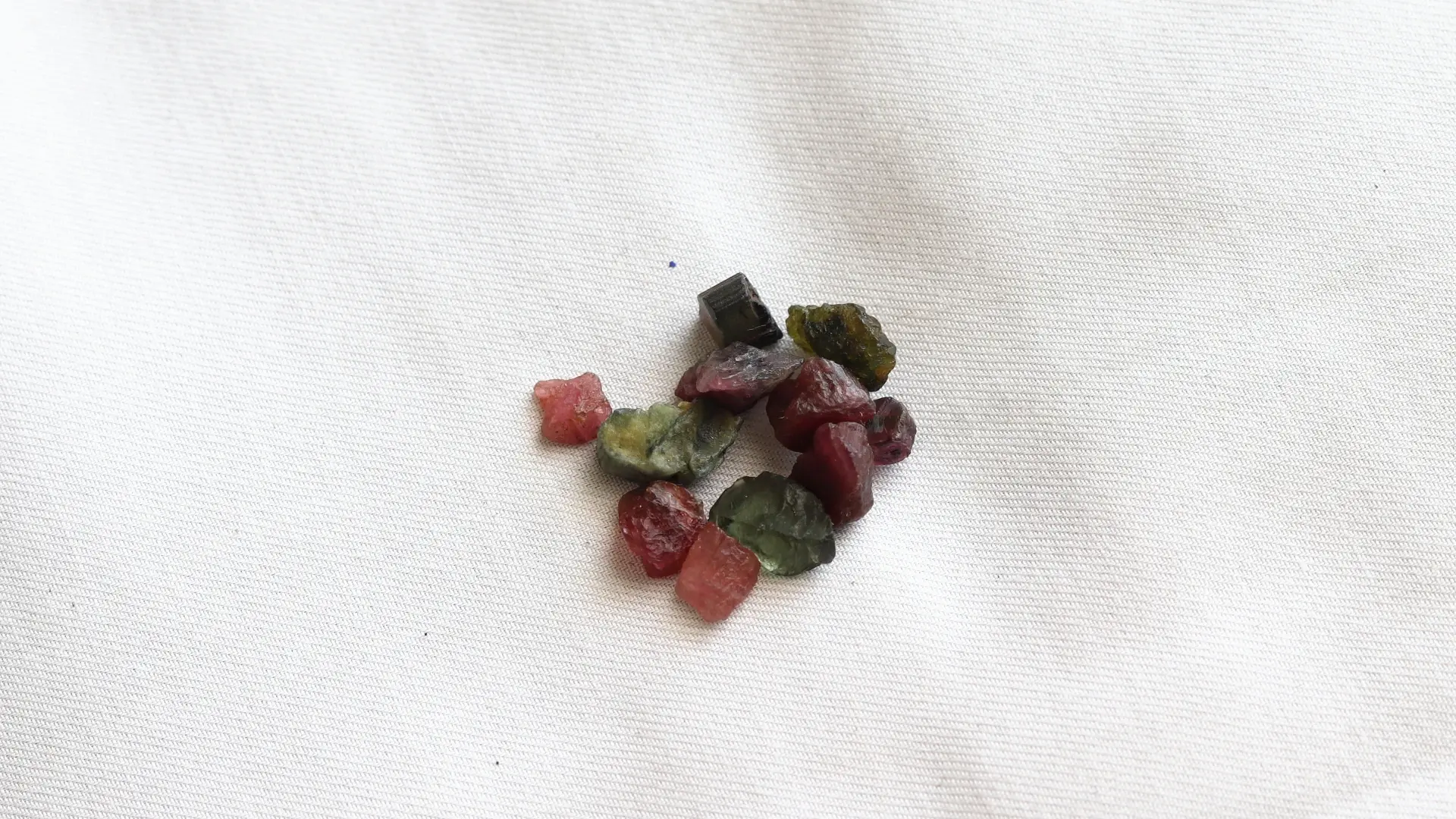
Multi-colour Tourmaline
A handful of rough crystals in pink, red and green. Tourmaline has one of the widest color ranges of any gem, sometimes with several colors in a single crystal.
Tourmaline is not one mineral but a whole group of minerals, and according to GIA it has one of the widest color ranges of any gem. The photo shows a small handful of rough, unpolished crystals: pink, red, green, and one dark green that is almost black.
Where do all the colors come from? According to GIA, traces of iron, and possibly titanium, give green and blue, and manganese gives red and pink. According to Wikipedia, in many pink tourmalines the color slowly deepened thanks to natural radiation from the surrounding rock. And sometimes the fluid a crystal grows in changes its chemistry halfway through, and the crystal changes color along with it. That is how "watermelon" tourmaline forms: green on the outside and pink on the inside. A crystal that kept a diary in colors.
Tourmaline has an electric side too: it becomes charged when heated, and according to GIA also when squeezed. According to Wikipedia, when the Dutch East India Company brought it to Europe from Ceylon, it was called the "Ceylonese Magnet", because it attracted hot ashes and then repelled them. And according to Hebrew Wikipedia, crystals displayed under strong lighting can become charged and pull in a layer of dust. A stone you clean that immediately gets itself dirty again.
Because of its colors, tourmaline was confused with other stones for centuries. According to GIA, the first recorded green crystal was found in Brazil in 1554 and was called "Brazilian emerald". According to Hebrew Wikipedia, red tourmaline was called "Siberian ruby", although it has nothing to do with ruby. And according to Wikipedia, China's Empress Dowager Cixi loved pink tourmaline so much that she bought large quantities of it from a mine in California.
And if you are holding a whole crystal, look for a triangle. According to GIA, tourmaline grows in three-sided prisms, and no other common mineral does. According to Wikipedia, the faces often have grooves running the length of the crystal, and you can see them on the dark crystal at the top of the photo.
Crystal traditions
In crystal tradition
According to Crystal Vaults, an Egyptian legend tells how tourmaline made its way from the center of the Earth, passed over a rainbow, and took all of its colors with it.
The site links both pink and green tourmaline to the heart chakra. According to the site, pink relates to the emotions and green to the physical body, and their combination in watermelon tourmaline is considered "a super activator of the Heart Chakra". According to the site, tourmaline is the zodiac stone of Libra.
Sources: Pink Tourmaline Healing Properties, Meanings, and Uses, Crystal Vaults; Green Tourmaline Healing Properties, Meanings, and Uses, Crystal Vaults
Scientific information
Properties
Chemistry: a group of complex boron aluminium silicates, with elements such as sodium, lithium, iron, magnesium and manganese. Most gem tourmaline is the species elbaite.
Mohs hardness: 7 to 7.5.
Specific gravity: about 3.06.
Crystal system: trigonal. Three-sided prisms, often grooved along their length.
Electricity: pyroelectric (charged by heating) and piezoelectric (charged by pressure).
Colors: almost every color. Bicolored and multicolored crystals are common, because the fluid's chemistry changes while the crystal grows.
Formation: in granite and granite pegmatites, and in metamorphic rocks such as schist and marble.
Sources: Brazil, many African countries (including Tanzania, Nigeria, Madagascar and Mozambique), Pakistan, Afghanistan, Sri Lanka and the United States.
Sources: Tourmaline, GIA; Tourmaline, Wikipedia; טורמלין, ויקיפדיה
Modern interpretations
Modern customs
Along with opal, tourmaline is a birthstone for October. It is also the gem of the eighth wedding anniversary.
Sources: Tourmaline, GIA
Associations
Different traditions associate this stone with different things, and they sometimes conflict. Each association is shown with its tradition and sources.
Zodiac sign
LibraCrystal tradition
Sources: Pink Tourmaline Healing Properties, Meanings, and Uses, Crystal Vaults; Green Tourmaline Healing Properties, Meanings, and Uses, Crystal Vaults
Chakra
HeartCrystal tradition
Sources: Pink Tourmaline Healing Properties, Meanings, and Uses, Crystal Vaults; Green Tourmaline Healing Properties, Meanings, and Uses, Crystal Vaults
Sources
- Tourmaline, GIAAccessed September 24, 2026
- Tourmaline, WikipediaAccessed September 24, 2026
- טורמלין, ויקיפדיהAccessed September 24, 2026
- Pink Tourmaline Healing Properties, Meanings, and Uses, Crystal VaultsAccessed September 24, 2026
- Green Tourmaline Healing Properties, Meanings, and Uses, Crystal VaultsAccessed September 24, 2026
More crystals
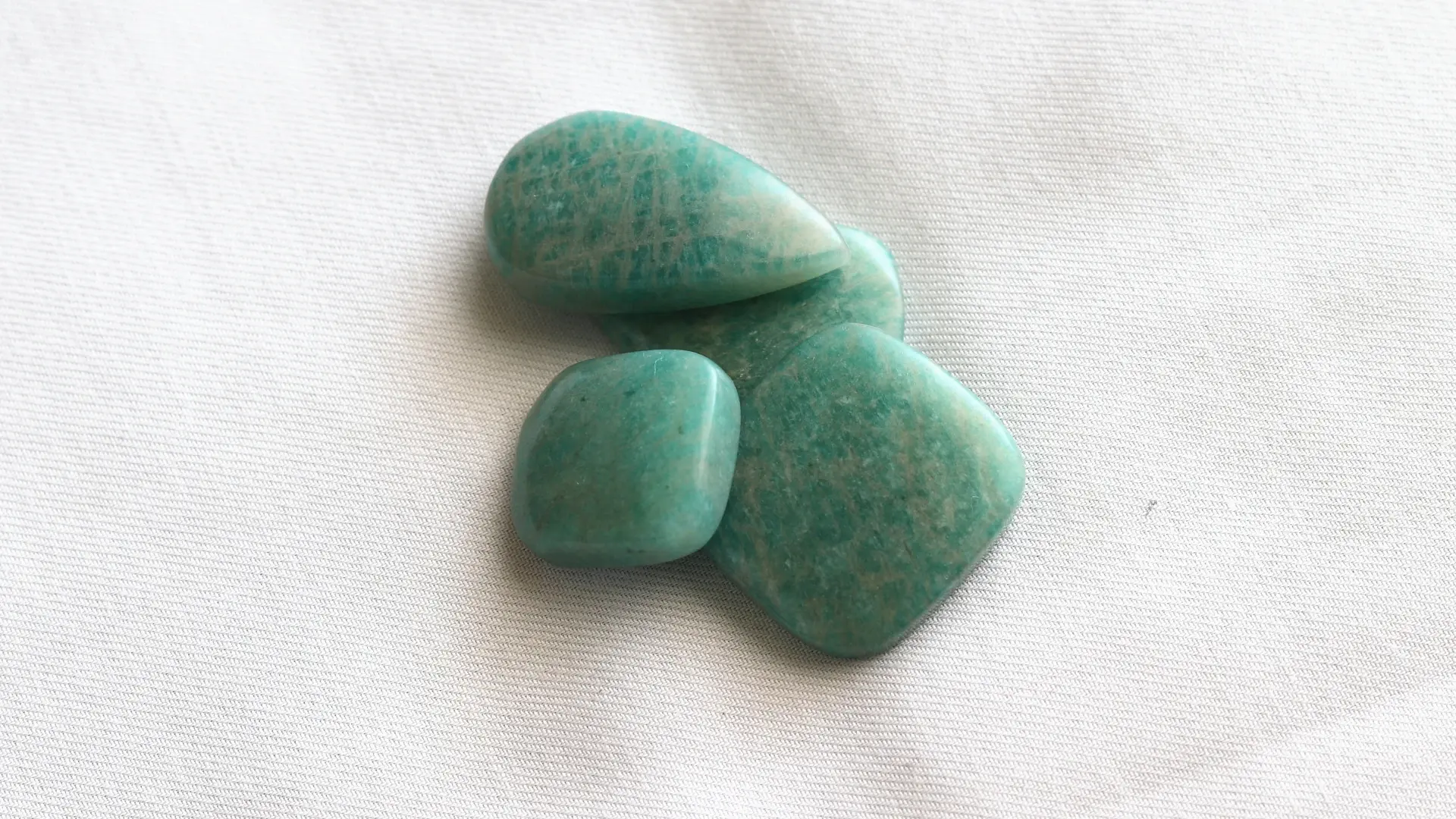
Amazonite
A turquoise-green variety of the feldspar microcline. Despite the name, it does not come from the Amazon.
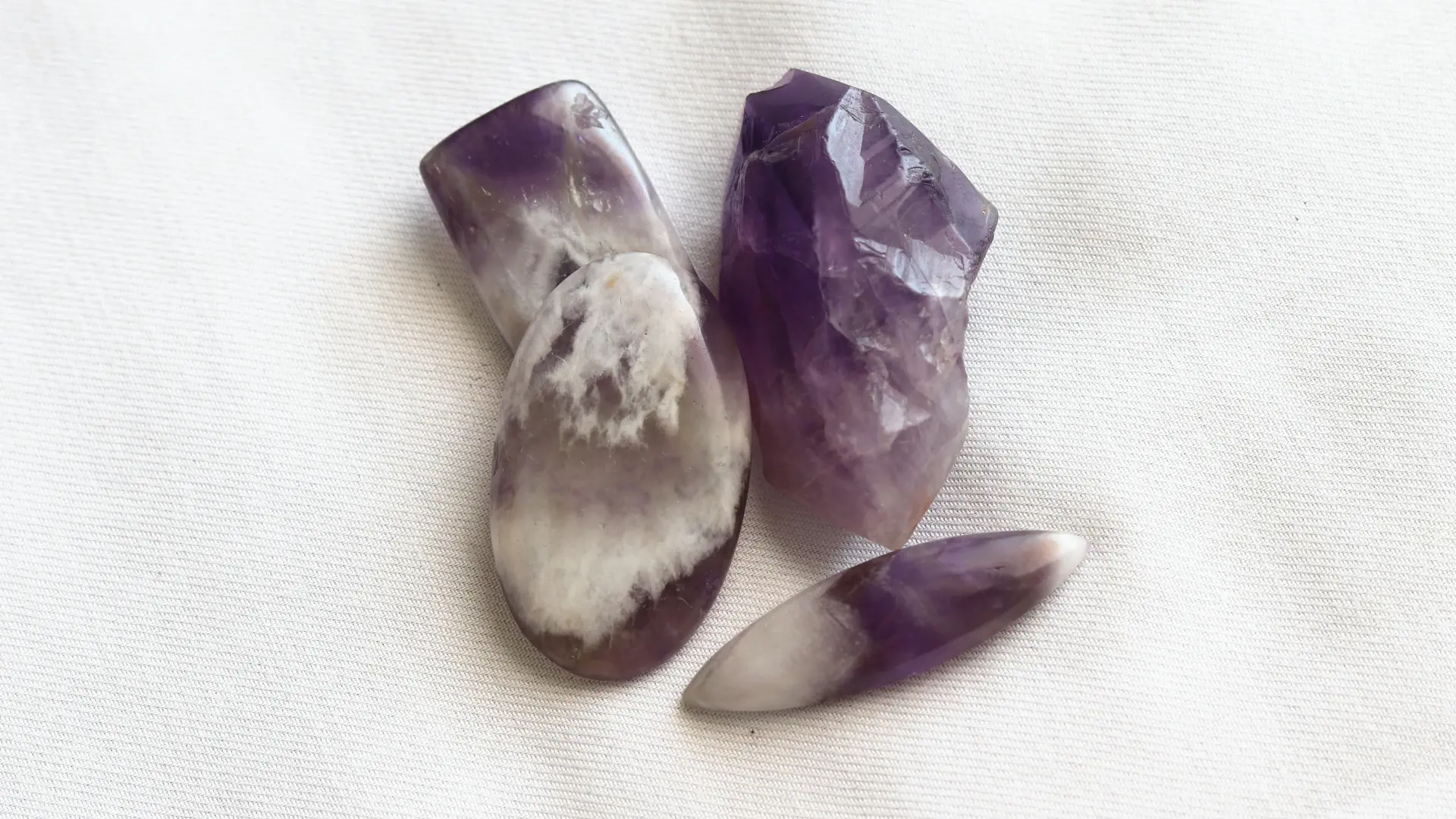
Amethyst
Purple quartz whose Greek name means "not drunk". By the common identification, one of the breastplate stones, and one of the best-loved stones in the world.
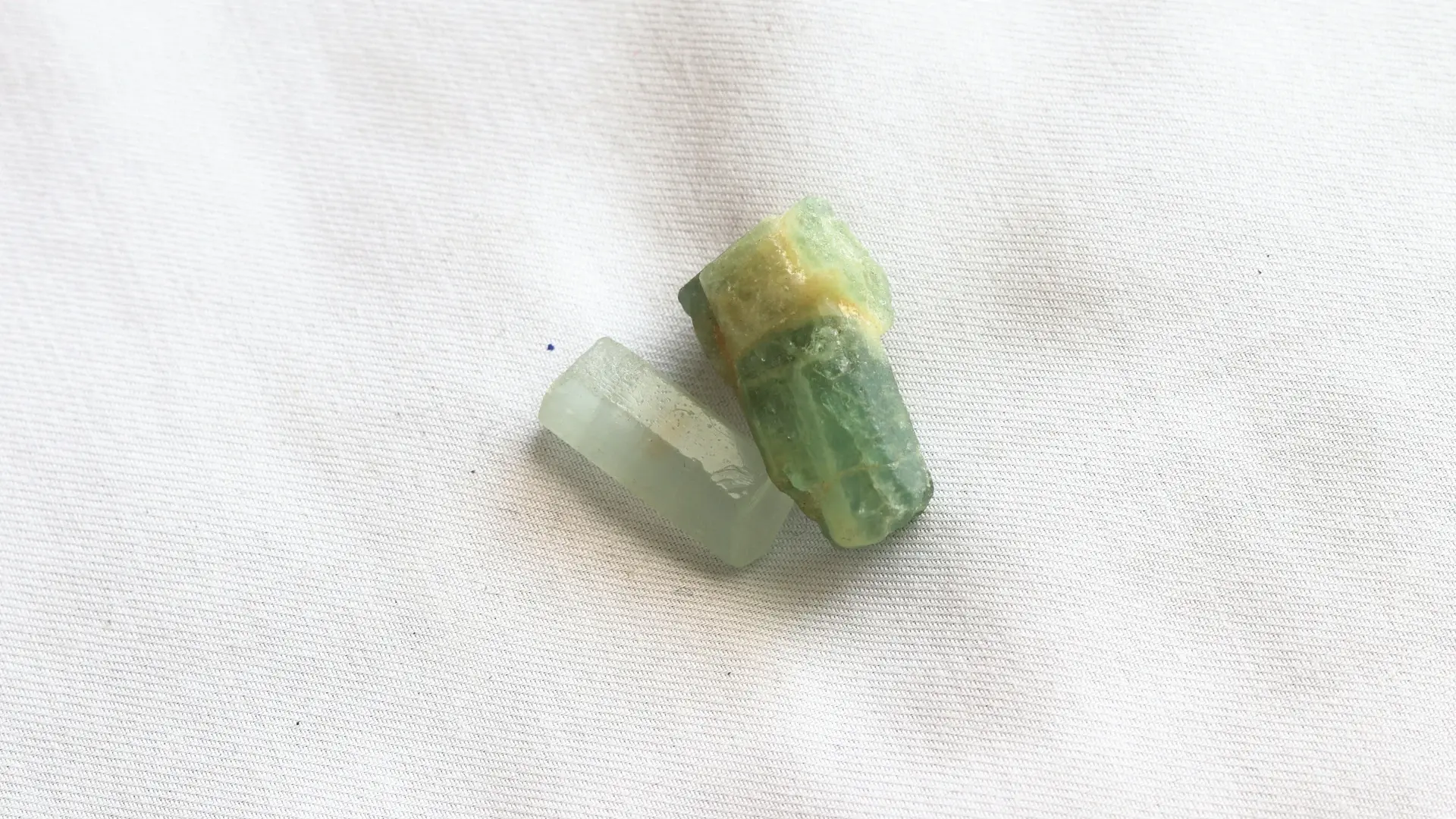
Aquamarine
The blue-green variety of beryl, a close relative of emerald. Its name means "seawater".
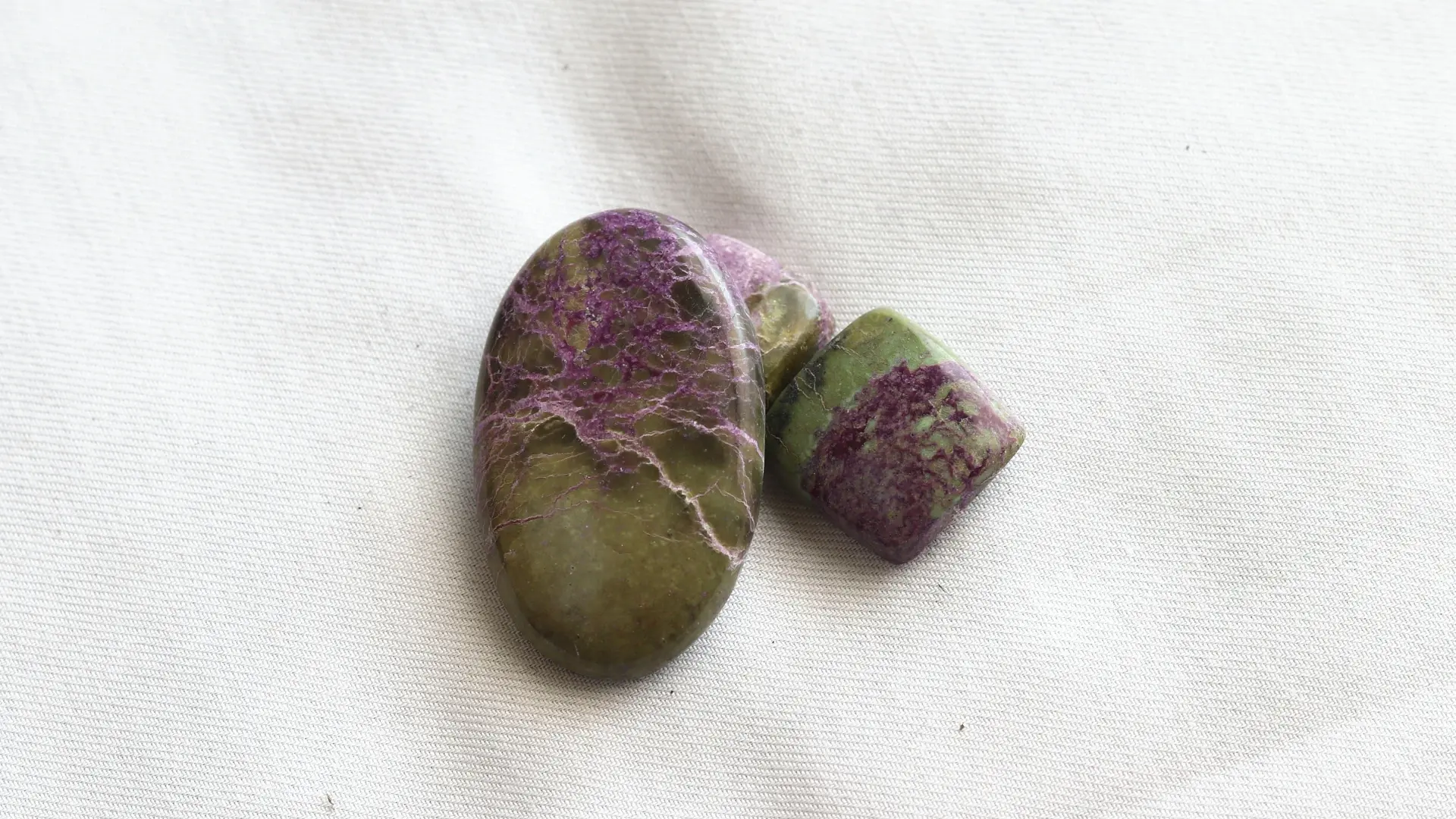
Atlantisite
A natural mix of green serpentine and purple stichtite, from a single hill in Tasmania.