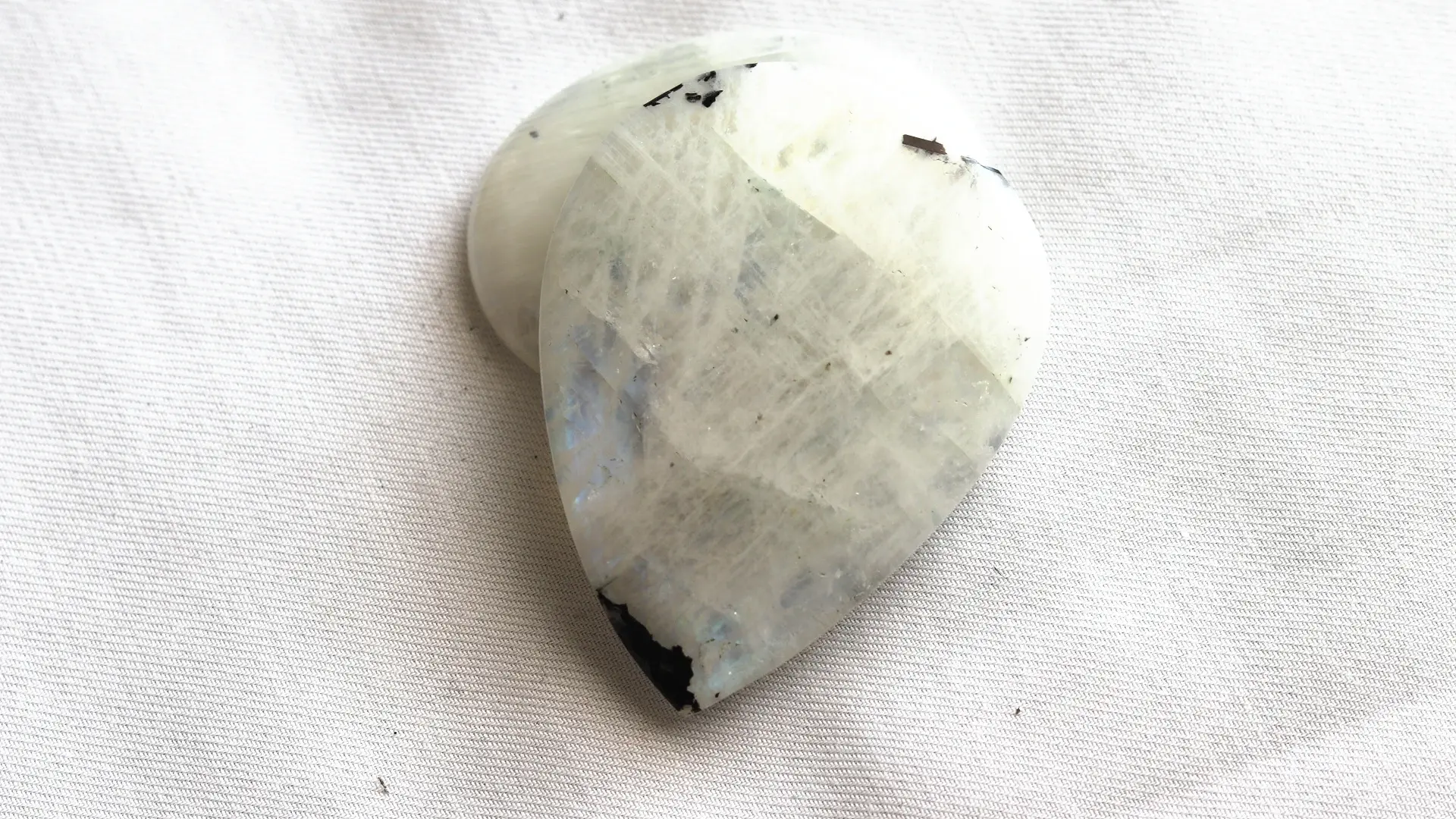
Rainbow Moonstone with Black Tourmaline
A white stone with a blue glow and black specks. Its name promises two things, and both are more complicated than they sound.
The photo shows two white teardrop-shaped stones. Move them in the light, and a bluish glow appears. Inside there are thin black streaks, and one of them has a large black patch at its tip. Shops call this stone "rainbow moonstone with black tourmaline". Lovely, but the two key words in the name are not quite accurate.
Let's start with "moonstone". Classic moonstone is orthoclase, a potassium feldspar. According to Wikipedia, what gem lovers call "rainbow moonstone" is usually labradorite, a feldspar from a different group, the plagioclases. According to Geology.com too, its colors usually come from labradorite: white light splits into rainbow colors inside the stone. So it is not exactly moonstone, but it is definitely family, and it has the same glow.
Now for "black tourmaline". Black tourmaline is called schorl, and it is the most common kind of tourmaline. According to Wikipedia, 95% or more of all tourmaline in nature is schorl. But according to an analysis published by the Dutch site Stapel van Stenen, the black mineral found in rainbow moonstone from India was identified as biotite, a mica, and not tourmaline. We have not tested the stones in the photo in a lab, so we do not know what is in them. One thing is certain: there is something black in there.
So: one stone, and two words in its name that might need fixing. That takes nothing away from its beauty. A lot of rainbow moonstone comes from India, and according to a 2024 GIA article, fine rainbow moonstone has also been found in Madagascar. Keep in mind that labradorite, like all plagioclases, tends to split: according to Wikipedia, it has three directions of cleavage. So better not to drop it on a stone floor.
For the stories about the Romans, who thought moonstone was made of solidified moonbeams, and about Florida, see the grey moonstone page.
Crystal traditions
In crystal tradition
According to Crystal Vaults, rainbow moonstone "acts as a prism", diffusing energy throughout the aura. The site describes it as a stone of psychic protection that aids lucid dreaming and calm sleep and connects with the energies of nature. Of moonstones in general, it writes that they are linked to the crown chakra and to Cancer.
Of black tourmaline, the site writes that it is "a premier talisman of protection" that deflects negative energies and grounds, and links it to the root chakra. On the zodiac the site is not consistent: a heading names Pisces, while the text itself names tourmaline as one of the stones of Libra.
Sources: Moonstone Healing Properties, Meanings, and Uses, Crystal Vaults; Black Tourmaline Healing Properties, Meanings, and Uses, Crystal Vaults
Scientific information
Properties
Composition: usually labradorite, a feldspar of the plagioclase series (albite–anorthite). Not orthoclase like classic moonstone.
Crystal system: triclinic.
Specific gravity: 2.68 to 2.72 (labradorite).
Cleavage: three directions, two of them good to perfect.
Optical effect: a rainbow-colored glow (adularescence), made when white light splits into colors inside the stone.
Black inclusions: sold as black tourmaline (schorl). According to one analysis, the black mineral in rainbow moonstone from India is biotite.
Sources: India and Madagascar, among others.
Sources: Moonstone (gemstone), Wikipedia; Labradorite, Wikipedia; Moonstone: Gems with a white, silver, blue or rainbow glow, Geology.com; Moonstone, GIA; Tourmaline, Wikipedia; Analysis: Rainbow moonstone, Stapel van Stenen
Modern interpretations
Modern customs
Moonstone is one of the birthstones for June, along with pearl and alexandrite.
Sources: Moonstone, GIA
Associations
Different traditions associate this stone with different things, and they sometimes conflict. Each association is shown with its tradition and sources.
Zodiac sign
CancerCrystal tradition
The source refers to moonstone in general.
Sources: Moonstone Healing Properties, Meanings, and Uses, Crystal Vaults
Zodiac sign
LibraCrystal tradition
UncertainThere is not enough evidence to decide.
The source refers to tourmaline and is not consistent: one heading on the page names Pisces.
Sources: Black Tourmaline Healing Properties, Meanings, and Uses, Crystal Vaults
Chakra
CrownCrystal tradition
The source refers to all moonstones.
Sources: Moonstone Healing Properties, Meanings, and Uses, Crystal Vaults
Chakra
RootCrystal tradition
The source refers to black tourmaline. The black inclusions in this stone may not be tourmaline.
Sources: Black Tourmaline Healing Properties, Meanings, and Uses, Crystal Vaults
Sources
- Moonstone (gemstone), WikipediaAccessed September 24, 2026
- Labradorite, WikipediaAccessed September 24, 2026
- Tourmaline, WikipediaAccessed September 24, 2026
- Moonstone: Gems with a white, silver, blue or rainbow glow, Geology.comAccessed September 24, 2026
- Moonstone, GIAAccessed September 24, 2026
- Analysis: Rainbow moonstone, Stapel van StenenAccessed September 24, 2026
- Moonstone Healing Properties, Meanings, and Uses, Crystal VaultsAccessed September 24, 2026
- Black Tourmaline Healing Properties, Meanings, and Uses, Crystal VaultsAccessed September 24, 2026
More crystals
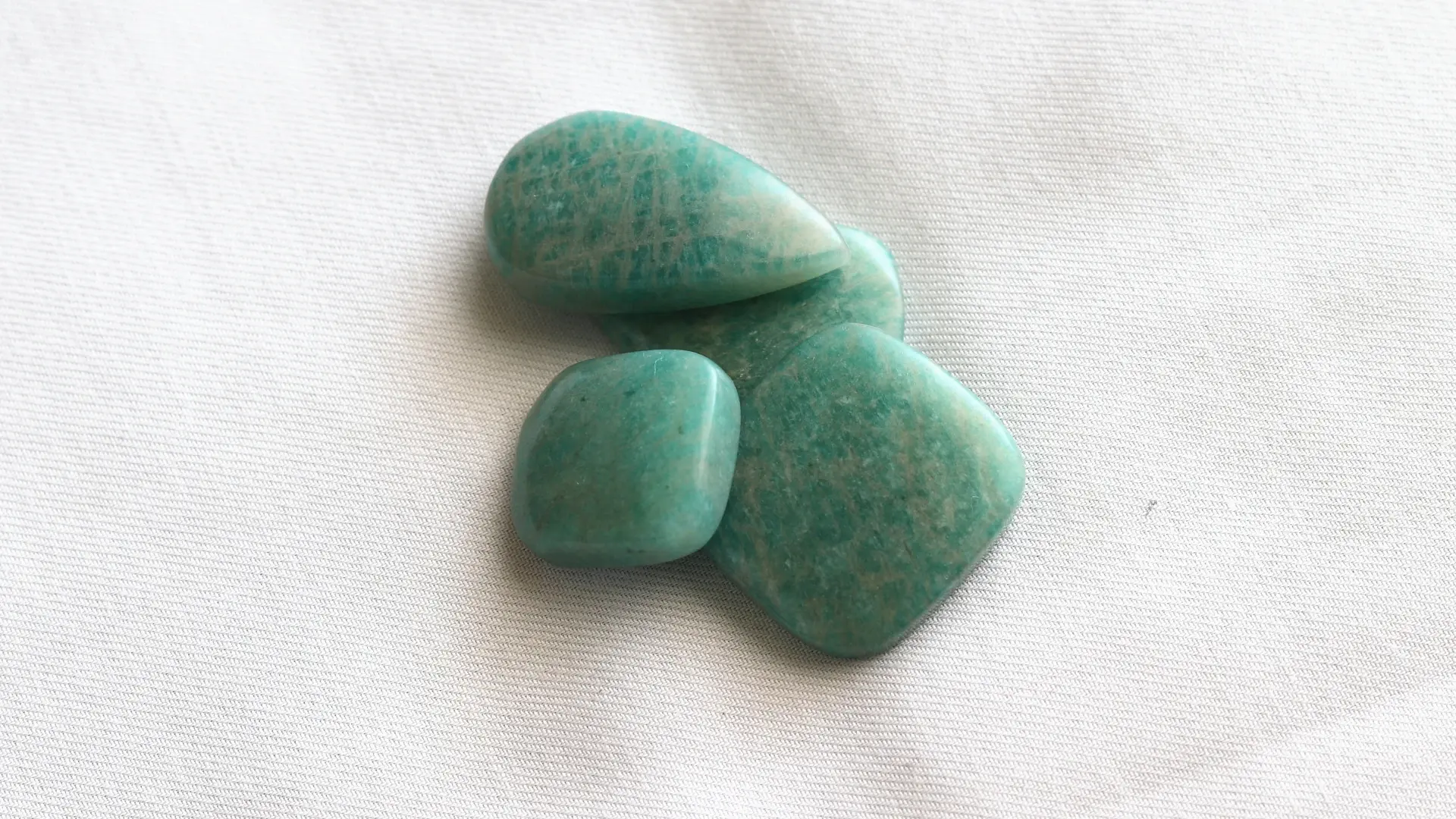
Amazonite
A turquoise-green variety of the feldspar microcline. Despite the name, it does not come from the Amazon.
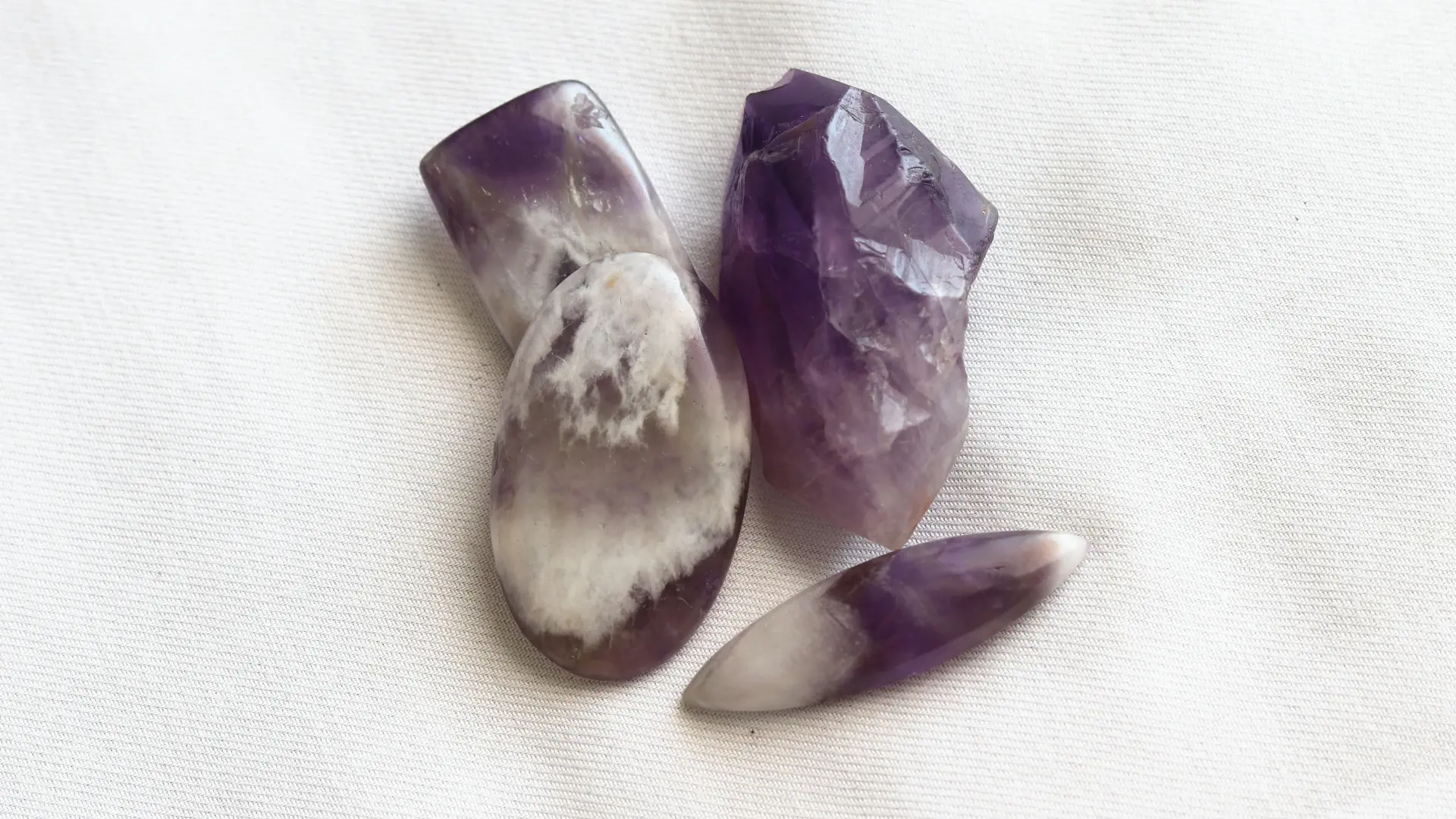
Amethyst
Purple quartz whose Greek name means "not drunk". By the common identification, one of the breastplate stones, and one of the best-loved stones in the world.
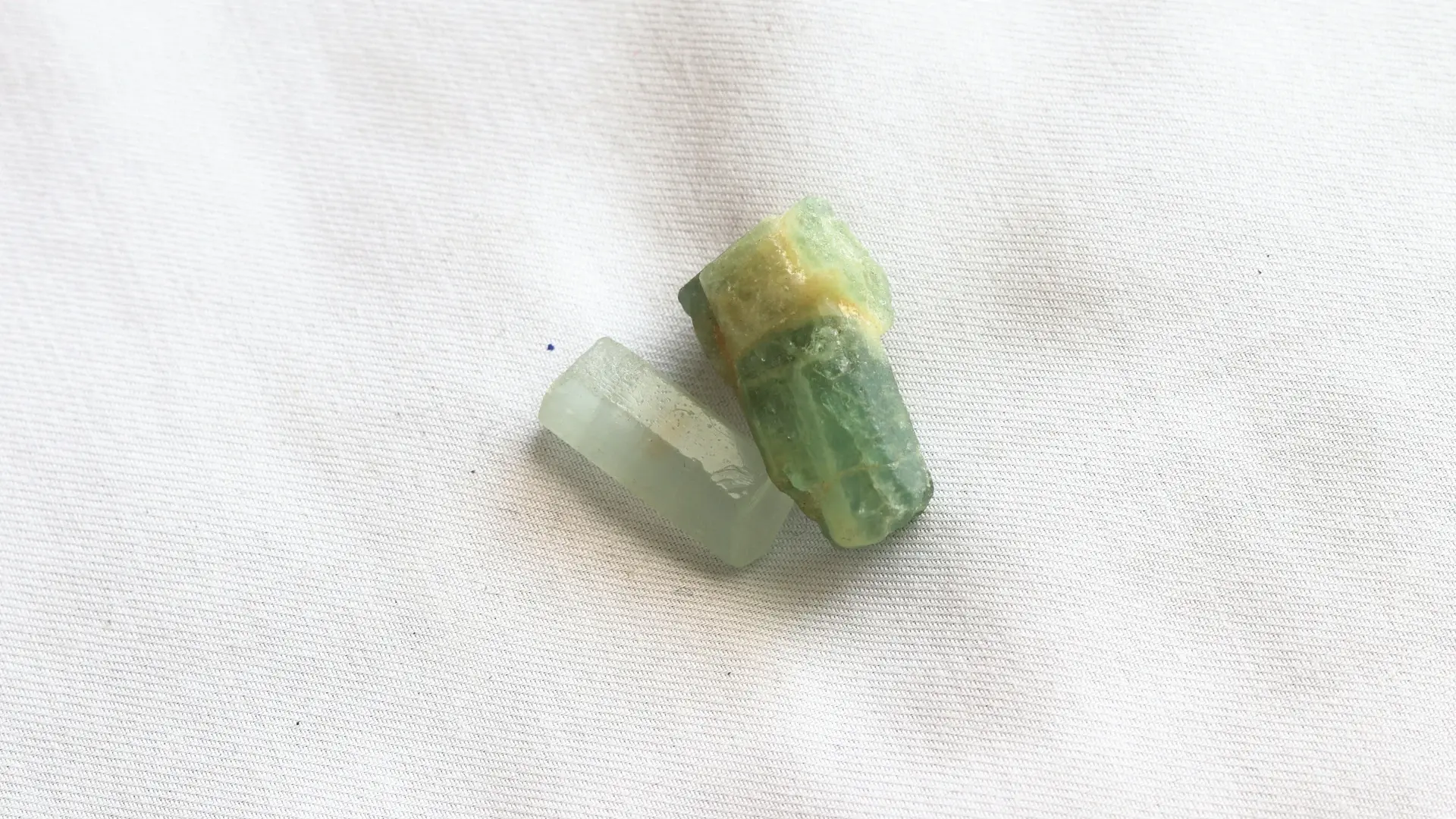
Aquamarine
The blue-green variety of beryl, a close relative of emerald. Its name means "seawater".
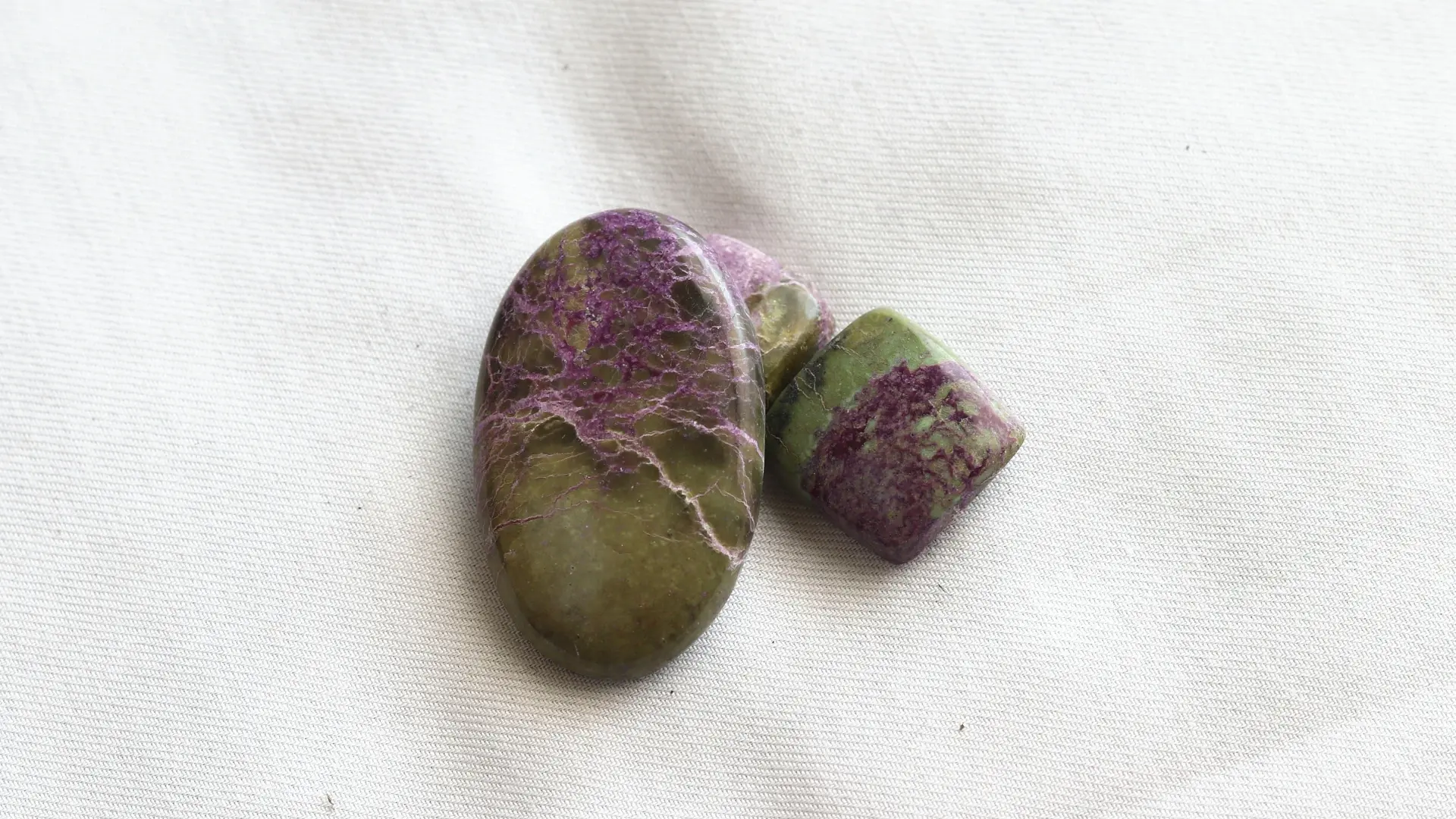
Atlantisite
A natural mix of green serpentine and purple stichtite, from a single hill in Tasmania.